Guide · 8 minute read
How to make a large print puzzle book
How to make a large print puzzle book for KDP: who buys them, font and grid sizes, trim size, layout and covers, with practical numbers and checks.
Last updated
Large print puzzle books are a big and steady part of the puzzle book market. They are bought by older readers who want to keep their minds active, by people with low vision, and very often by family members buying a gift. These readers are clear about what they want, and quick to say so in a review when a book doesn't deliver. This guide covers what "large print" should mean in practice.
Who buys large print puzzle books
Most buyers are older adults, or people buying for them: a daughter buying for a parent, a care home stocking a lounge, a grandchild buying a birthday present. That shapes the book in a few ways:
- Comfort comes first. Big type, clear grids and plenty of white space matter more than squeezing in extra puzzles.
- A gentle start is welcome. Many readers want to warm up; a book that opens with very hard puzzles can feel unfriendly.
- Familiar puzzles sell. Word search, sudoku and easy crosswords are the classics. Fill-ins and number search are popular too.
- The cover has to say it. Buyers search for "large print", and they look for it on the cover thumbnail.
Trim size: 8.5 x 11
Use 8.5 x 11 for large print. It gives the biggest page KDP offers for paperbacks, so grids and type can be as large as possible. 8 x 10 also works if you prefer a slightly smaller book. Smaller trims, such as 6 x 9, make it hard to call a puzzle book large print honestly, because everything has to shrink to fit.
Paper colour is a matter of taste. White gives the most contrast. Some readers find cream softer on the eyes.
One puzzle per page
Large print books should give each puzzle its own page. Two puzzles per page halves the size of each grid, which defeats the point. In Puzzlil, turning on Large Print automatically switches the book to one puzzle per page.
Type and grid sizes
There isn't a single KDP rule for what counts as large print in a puzzle book, so use your judgement and test on paper. Some practical guidance:
- Make all the text bigger, not only the grid. Word lists, clues, instructions, headings and page numbers all need to be readable.
- Choose a clear font. Simple sans-serif fonts with open letter shapes are easiest to read. Atkinson Hyperlegible, one of the 18 interior fonts in Puzzlil, was designed specifically to make similar letters (like I, l and 1) easy to tell apart.
- Give grid squares room. Readers need space to write in a sudoku square or circle a word. On an 8.5 x 11 page, a sudoku grid can fill most of the page width.
- Print a test page. Hold it at arm's length. If you squint, the type is too small.
Puzzlil's Large Print setting makes the type bigger throughout the book: grids, word lists, clues and instructions.
Difficulty
Most large print buyers want puzzles they can finish. A good pattern is to start Gentle and build slowly, so the book has a satisfying climb without a wall at the end. In Puzzlil, use the Gentle level, or turn on the easy-to-hard ramp so the difficulty rises through each section.
Every puzzle should have exactly one answer. That matters for every reader, but large print readers are especially likely to give up on a puzzle that seems unsolvable, and to blame the book.
Front and back matter
Some small touches help:
- A how-to-play page for each puzzle type, in plain words.
- A contents page if the book has more than one type of puzzle.
- An answer key at the back, also in a readable size, numbered to match. See how to add answer keys.
- A short note from you, if you like, at the back.
Margins and page count
Large print books often have fewer puzzles per page, so they get long quickly. Remember the gutter grows with page count: 0.375 in up to 150 pages, 0.5 in from 151 to 300, and more after that. Set margins after you know the final count, including the answer key. The margins guide has the full table, and the margin calculator does the work for you.
The cover
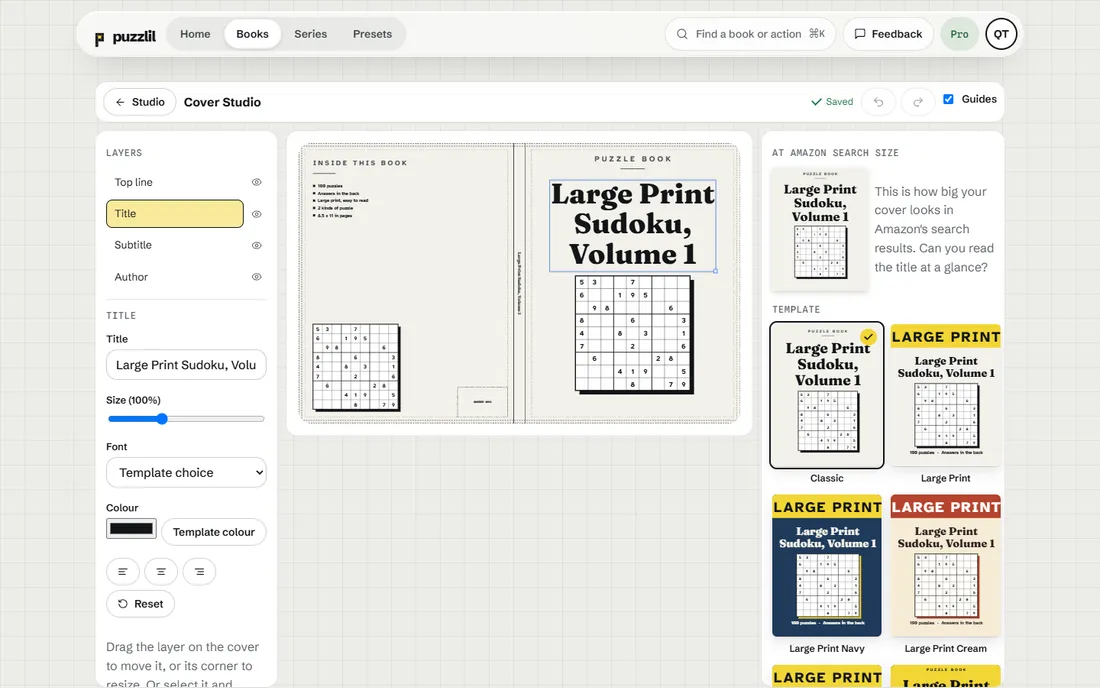
Put LARGE PRINT clearly on the front, big enough to read in a small search result thumbnail. Make the title high-contrast and simple. Say what kind of puzzles are inside and, if you like, how many. Puzzlil has large print cover templates with a bold LARGE PRINT band in several colours.
The listing
Use "Large Print" in the title or subtitle if the book truly is large print, and mention it again in the description. Say who the book is for, the number of puzzles, the difficulty and the trim size. Don't overstate: if a buyer receives small type in a "large print" book, the review will say so.
A quick checklist
- 8.5 x 11 trim, one puzzle per page.
- Bigger type everywhere, in a clear font.
- Gentle start; every puzzle with one answer.
- How-to page, contents if mixed, readable answer key.
- Gutter set for the final page count.
- LARGE PRINT clearly on the cover and in the listing.
- Preview in KDP, and print a proof.
Puzzlil's Large Print switch, gentle levels, large print cover templates and KDP checks cover most of this list for you. You can see the large print options on the large print puzzle books page.
Common large print mistakes
Large grids, small word lists. A big grid with a tiny word list underneath is not large print. Readers need to read the list as easily as the grid.
Too many puzzles per page. Two per page halves every grid. Large print means one per page.
Thin, decorative fonts. Script or condensed fonts are harder to read at any size. Choose a plain, open font.
Low contrast. Pale grey grids or coloured backgrounds reduce contrast. Black on white or cream is easiest to read.
Hard puzzles first. A large print reader who can't solve the first page may not try the second. Start gently.
A cover that doesn't say it. If LARGE PRINT isn't readable on the cover thumbnail, many buyers won't know the book is for them.
Testing your book
Before you publish, print a few pages at home at actual size, or order a proof copy. Give them to someone in your target audience if you can. Ask them to solve a puzzle and read the word list and the answer key. Five minutes of real feedback catches problems no checklist will.
Questions
What font size counts as large print?
There is no single KDP rule for puzzle books. Many publishers aim for clue and list text well above normal book text. Print a test page and read it at arm's length.
Is cream or white paper better for large print?
Both work. Some readers find cream softer on the eyes; white gives the most contrast.
Can I call my book large print?
Only if it really is. Put the words on the cover and in the title or subtitle so buyers can find it.